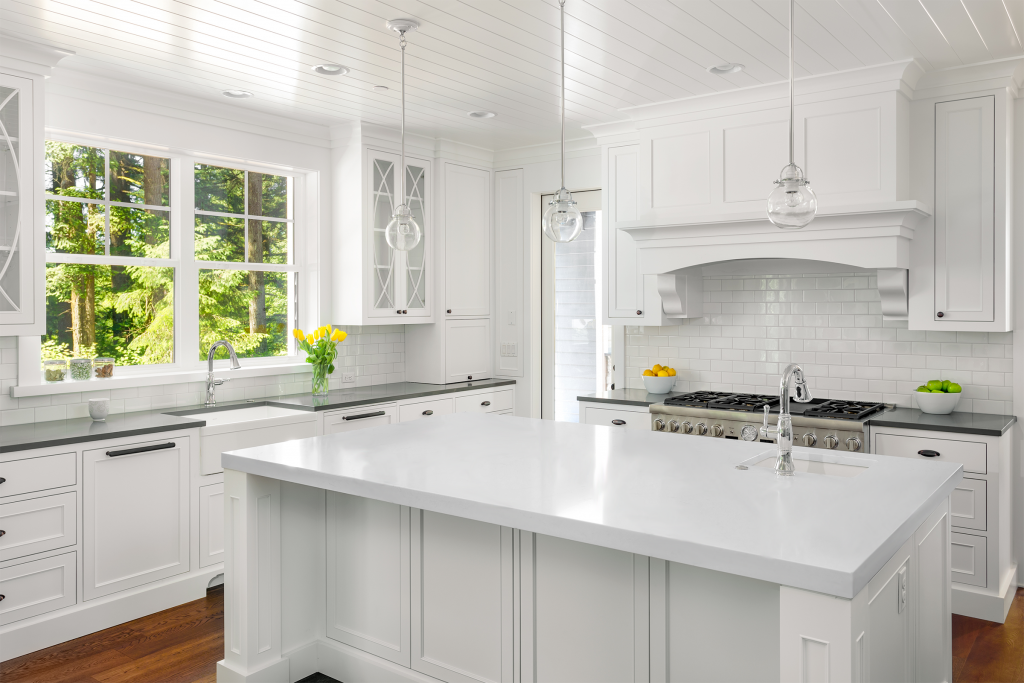
Your backsplash sits just inches above your countertop, so even small mismatches in tone or pattern tend to stand out. At True Blue Surfaces, we work with homeowners across Austin and San Antonio to fabricate countertops that pair well with tile, and in many cases we fabricate the backsplash itself out of matching stone. Here’s how we approach the pairing.
Why Backsplash and Countertop Pairing Matters
The backsplash and countertop sit closer together than almost any other two surfaces in a kitchen, which means even subtle clashes in undertone or pattern become obvious fast.
A countertop with cool gray veining next to a backsplash tile with warm beige tones can feel disjointed, even if both materials are attractive on their own. Getting the pairing right ties the whole space together.
This matters whether you’re choosing a granite, marble, quartz, or quartzite countertop, since each material carries its own color depth and movement that the backsplash needs to complement.
Matching vs. Complementary: Two Approaches
There are two general strategies for pairing backsplash and countertop, and both can work well depending on the kitchen.
A matching approach uses the same or a very similar stone for both surfaces, often the same slab, cut and finished for a continuous, seamless look. This works particularly well with quieter stones like a solid quartz or a subtly veined marble.
A complementary approach uses a different but coordinated material for the backsplash, such as a simple tile in a neutral tone behind a bold, heavily veined quartzite countertop. This lets the countertop stay the visual focus while the backsplash plays a supporting role.
We Do A Marvelous Job!
How To Choose a Backsplash That Matches Your Countertops?
Matching countertops and backsplash is part art and part practical decision-making, and it's something our team works through with clients across Central Texas every week.
Let Your Countertop’s Pattern Guide Grout and Tile Size
If your countertop has a lot of natural movement, like dramatic veining in a quartzite or marble slab, a busy tile pattern or heavy grout lines can compete with it rather than complement it.
In those cases, larger format tile with minimal grout lines, or a book-matched stone backsplash, tends to let the countertop remain the star of the kitchen.
For quieter, more uniform countertop materials, there’s more room to introduce pattern or texture through the backsplash without the two surfaces fighting for attention.
Pro Tip: Hold a tile or stone sample directly against your countertop slab, not just next to a paint chip or cabinet sample. Undertones that look neutral apart from each other sometimes clash once placed side by side.
Consider a Full-Height Stone or Slab Backsplash
One option we fabricate for homeowners who want true continuity is a full-height or slab backsplash cut from the same material as the countertop. Our porcelain slab options are well suited to this approach, since they install with minimal grout lines and mimic the look of continuous natural stone.
This creates a seamless transition from countertop to wall, with no grout lines to interrupt the stone’s veining or pattern. It’s a striking option for a statement kitchen wall or a range hood surround.
We can walk you through whether a matching slab backsplash makes sense for your material choice and layout, or whether a coordinated tile approach fits your project and goals better.
Let’s Find Your Backsplash and Countertop Pairing
Coordinating a backsplash with your countertop is easier with the full slab in front of you rather than a small sample, which is one reason we recommend visiting our design center before finalizing tile selections.
If you’re still comparing countertop materials, our granite versus quartz comparison can help you narrow down a direction before you start shopping for backsplash options.
Ready to plan your kitchen’s countertop and backsplash pairing? Contact True Blue Surfaces today, and our team will help you put together a cohesive look from counter to wall.