
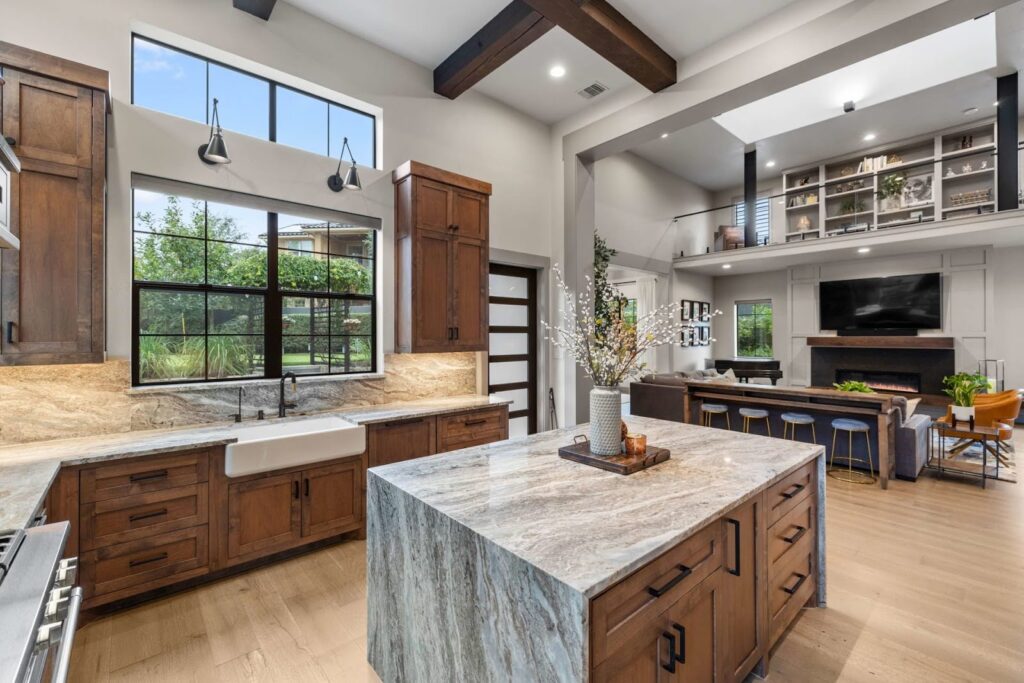
Central Texas homes face a specific set of conditions: strong sun, high heat, and hard water. Those factors affect how a countertop looks and lasts, so the material you choose matters.
We fabricate and install stone for homes across Austin and Central Texas from our local shops. Here are the surfaces that hold up best in our climate, and how to choose the right one.
What a Dry Climate Means for Your Countertops
A dry, sunny climate brings a few challenges. Intense sun can fade some surfaces over time, high heat calls for heat-resistant materials, and hard water leaves mineral spots.
The good news is that several surfaces handle all of this well, especially natural stone and porcelain.
Central Texas also has notably hard water, which leaves mineral deposits on surfaces. Non-porous materials wipe clean easily, while porous ones benefit from prompt cleanup and regular sealing.
Pro tip: Think about sun exposure first. A counter near a big window or in an outdoor space needs a UV-stable surface more than one tucked into a shaded kitchen.
Granite: Heat and Sun Ready
Granite is a natural stone that handles heat and sun without trouble. You can set a hot pan on it, and its color holds up under strong Texas light.
It needs periodic sealing, but otherwise it is low fuss and long lasting.
Its natural color also holds up where some engineered surfaces can struggle, since the stone is not affected by sunlight the way a resin-based product can be.
Pro tip: Granite works indoors and out, which makes it a flexible choice for a Central Texas home with an outdoor kitchen.
Quartzite: Tough Enough for Texas
Quartzite is one of the hardest natural stones. It resists scratches and heat, holds its color in the sun, and often carries a bright, marble-like look.
Like all natural stone, it needs sealing, but it stands up to a busy Texas kitchen well.
Pro tip: Quartzite is a strong pick if you want a light, airy look that can still take the heat. Just confirm your slab is true quartzite before you buy.
We Do A Marvelous Job!
What Are the Best Countertops for a Dry Climate?
In Central Texas, heat, sun, and hard water all affect how a surface holds up. Our Austin team helps you choose a countertop built for the local climate.
Porcelain: Built for Sun and Outdoor Spaces
Porcelain and sintered surfaces are made for tough conditions. They are non-porous, heat resistant, and hold their color under UV light, which suits sunny spots and outdoor kitchens.
They come in large, thin slabs that copy stone and concrete looks closely.
That large format also means fewer seams, which reads clean and gives dust and grime fewer places to collect in a dusty, dry climate.
Pro tip: For any counter in direct sun, porcelain is one of the safest choices. It will not fade the way some surfaces can under constant Texas light.
Quartz: Great Indoors, With One Caution
Quartz is a favorite for indoor kitchens because it is non-porous, low maintenance, and never needs sealing. It shrugs off hard water spots with a simple wipe.
The one caution is sun. Many quartz brands advise against direct, constant sunlight, which can fade or discolor it over time.
Pro tip: Keep quartz for indoor counters away from strong, direct sun. For a sunroom or outdoor space, choose porcelain or natural stone instead.
Do Not Forget Outdoor Kitchens
Outdoor living is big in Central Texas, and the right surface makes it last. For an outdoor kitchen, choose a material built for sun and weather, like porcelain, granite, or quartzite.
These handle heat, UV, and temperature swings without fading or cracking.
Pro tip: For an outdoor bar, a darker or busier pattern hides dust and pollen better than a light, solid color between cleanings.
Ready to Choose a Countertop Built for Central Texas?
The best countertop fits your home, your style, and our local climate. That is exactly what our team helps Austin area homeowners and builders find, from material selection to a precise install.
Bring us your project and let our team guide you the whole way. Request a free quote today, and let’s build countertops made to last in Central Texas.