
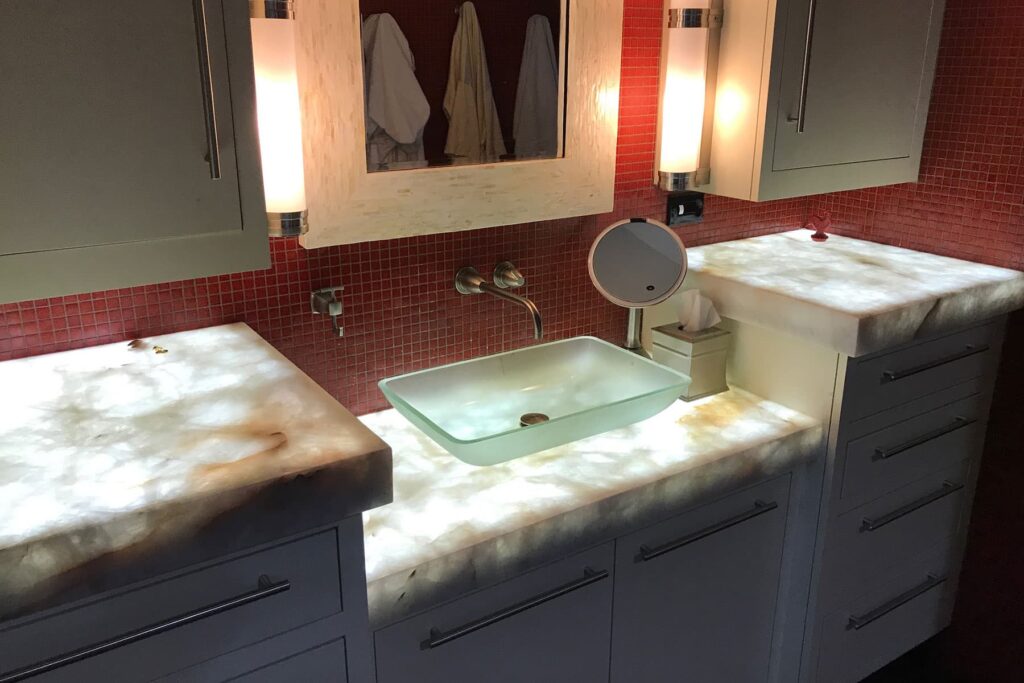
When you’re building a custom home or upgrading your kitchen or bathroom, your countertop choice makes a major difference in the feel and personality of your space.
For some homeowners, a standout countertop is more than just another kitchen surface; it’s the focal point of their entire design. In these cases, a simple slab just won’t do. If you want a truly unique kitchen countertop, your best choice might be an exotic countertop.
What Are Exotic Countertops?
“Exotic” countertops are either highly unusual patterns of conventional stone or unconventional countertop stones. The term is a catch-all for unique slabs, many of which are truly one of a kind.
Not every stone is suitable for countertop use. Exotic options include choices like onyx, travertine, and even petrified wood. Gemstones (usually semi-precious stones like lapis lazuli, amethyst, and agate) and geodes can be used, although the fabrication process for these is a little different than other exotics; while stones like onyx can be cut like traditional countertops, geodes and gemstones are stabilized with the same kind of ultra-durable, crystal-clear resin that is used in quartz countertops. This makes them stable, long-lasting surfaces that resist damage.

There are also exotic options for more traditional stones. Exotic slabs often come from Brazil, Madagascar, India, and quarries in geologically distinct areas, but the origin isn’t what makes them exotic; it’s how the stones look. Conventional stone slabs are deemed exotic if they have unusual mineral formations as inclusions or come in rare colors. So while granite is widely used, blue and green granite are considered exotic granite because the color is so unusual.
Intense veining can also push a stone into the exotic category. One of our favorite exotic granites is Matrix, a gray stone that doesn’t look anything like the typical granites used in countertop fabrication. Matrix’s veins are a heavy, interwoven web of striations that give the stone’s surface three-dimensional depth. Because it’s so different from any other granite, it gets classed as an exotic countertop– even though it’s the same granite you know and love.
Exotic Countertop Care
Your exotic countertop’s care will vary based on the type of stone you chose. Some exotic countertops, like rare marble slabs, are vulnerable to scratches and etching; others, like geode countertops, may require you to be careful with cleaning materials due to the composition.
Like all stone countertops, exotic countertops are generally low maintenance; you’ll just need to pay attention to specific details to get the best results. Your fabricator will be able to tell you everything you need to know about how to care for your exotic countertops, and will even have product suggestions.

Also, just like other countertop options, exotic countertops often require sealing. If you’re using a natural stone, it’s almost guaranteed that you’ll need to seal, since natural stones are almost all porous. Your countertop slab will be sealed as it’s manufactured, and with time and use, you will need to re-seal.
Every counter